Have you checked your blood glucose and HbA1c?
I do not have diabetes.
You may not have diabetes …yet!
I have no symptoms.
You may feel OK, even if your glucose levels are high.
I have a healthy lifestyle.
Even with a healthy lifestyle, one can get diabetes.
For a person with diabetes, the answers reflect more complex feelings.
I have not been doing it right. I understand I should be more disciplined (self-blame).
When it just doesn’t come down, I don’t feel like checking (disappointment, losing control)
I am scared to look at the values (fear)
I was really busy (priorities)
No-one told me to. (unaware)
What is HbA1c?? (ignorance)
I check sugars whenever I don’t feel OK. (relating glucose to symptoms)
I check regularly. (Self-assured, empowered person)
I am fed up of doing this for years. (burned out, frustrated)
I regularly see patients with diabetes who are reluctant to check their blood glucose or HbA1c regularly. The blood glucose values generate different feelings-some are afraid to see the result, some are disappointed or frustrated when the values are just not controlled. There is a feeling of loss of control. Some think taking medications is a sign of personal failure, some blame themselves when the glucose values are not in control.
The numbers become a nightmare for some, a mission for some. However, the numbers are just means to an end, not an end in themselves.
What if we do not look at these numbers as a report card, but like a crystal ball!
Data from lots of people with diabetes over decades help us predict our futures. In that sense, diabetes is not actually a disease because a person with diabetes may be completely at ease. It is an insight into our future risk of diseases like heart attack, kidney failure, blindness, foot ulcers and amputations all of which can really put a person into a lot of unease.
What is HbA1c?
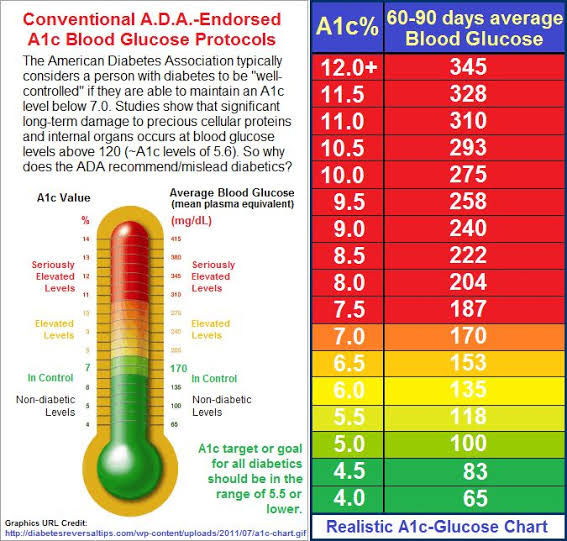
Hemoglobin is a protein inside red blood cells which carries oxygen from our lungs to every organ. Some hemoglobin binds to glucose in blood to form glycosylated hemoglobin or HbA1c. HbA1c gives us an idea about the average blood glucose over last 3 months.
HbA1c of 6% means blood glucose was about 120mg/dl in last few weeks, 7% means about 150mg/dl…roughly add 30mg/dl glucose for 1% HbA1c.
What level of blood glucose and HbA1c is used to define diabetes?
Diabetes is defined as of now by:
A fasting blood glucose more than 125mg/dl
A 2 hour postal blood glucose more than 200mg/dl
HbA1c more than 6.5%
These cutoffs are chosen from data which suggest that beyond these values the risk of eye damage start rising sharply.
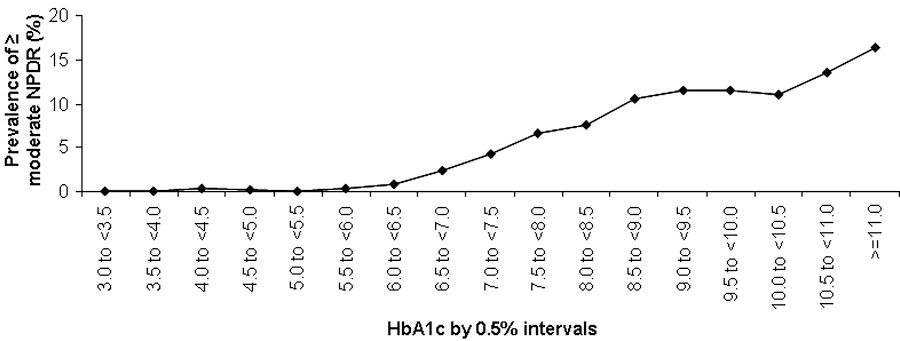
NHANES data, HbA1c and retinopathy
Is the future inevitable?
The future path depends on our present choices regarding exercise, diet and taking medications. Data show that HbA1c reduction of 1% reduces risk of complications by 25%.
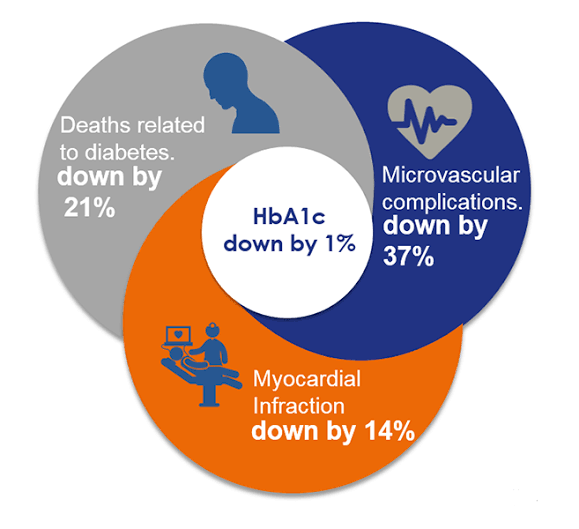
UKPDS data
The choices people make however depends on their awareness and understanding of these scientific data, their beliefs, advice and support from friends and families, socio-economic conditions, home and office environment etc.
What is my target for HbA1c?
The first large trial which led to most of our current understanding of the impact of glucose control on complications of diabetes came from UKPDS. This study was started in 1977, about 5000 people with newly diagnosed diabetes were randomised to two groups: one group (intensive group) was started on medicines as soon as the fasting blood glucose crossed 108mg/dl. The medications available at that time only a few-sulphonylurea, insulin and metformin. Today we are blessed to have many medicines to chose from. Second group (conventional group) was given medicines only when fasting glucose crossed 270mg/dl. After 10 years, the complications were less in the intensive group, strongly supporting early initiation of medications. The group which delayed medications had higher chances of complications of diabetes.
The mean HbA1c in intensive group was 7% and in the conventional group 7.9%.
The benefits persisted even after 10 years of stopping the study.
UKPDS data
Does this mean the lower the HbA1c, the better it is?
To answer this other trials more recently were planned to get lower HbA1c. ACCORD study had two groups: intensive group achieved a target HbA1c of 6.4%, standard therapy group achieved 7.5%. These patients were elderly patients with high risk of heart disease. The intensive group had no benefits but higher deaths and the study had to be stopped prematurely. The deaths may have been due to low glucose or hypoglycemia.
Hence this study clearly suggest that in elderly people, with long duration of diabetes, we may do more harm than good by an HbA1c lower than 6.5%, especially if the patient is on medicines causing low sugars.
To summarise, HbA1c target should be..
Less than or equal to 6.5% in…
Young newly diagnosed people with type 2 diabetes, especially if they are on medicines which do not cause hypoglycaemia.
6.5-7% in..
Middle aged people, duration of diabetes 5-10 years, or on medicines which can cause hypoglycemia
7-7.5%..
Old patients, duration of diabetes more than 10 years, especially of they are on medicines causing low sugars.
More than 7.5%..
Life expectance less than 10 years, co morbidities, potential for hypoglycemia
The targets, medicines, risks and benefits of course need to be discussed with patients who can then take part in the decision making of what their HbA1c should be. After all doctors are just facilitators in this crystal gazing, the choices and future lies in the hand of the patients themselves.
 door to care
Leave a comment